Comparison with Other Diets

How do SLIM TLC and The Nutrition Star line up?
This analysis was done by Open Evidence. Click on this link to see the full search. If your dietary preference falls short in some way, note that because of its flexibility, you can adapt The Nutrition Star to any diet you prefer, and still use SLIM TLC, especially adapted versions (per your judgement) of the SLIM TLC Map and the "Free Food? Whatever!" eating strategy to implement it – and also help you make all the other Therapeutic Lifestyle Changes needed to achieve your goals.
How the Nutrition Star + SLIM TLC Compares to 21 Popular Diets
This guide shows how your program stacks up against 21 of the most popular diets and eating plans, based on the best available scientific evidence. Understanding these comparisons can help you feel confident in your approach — and understand why some diets that sound appealing may not be the best choice for your long-term health.
How to Read This Guide
The 21 diets are organized into five groups based on their approach. For each diet, you will find:
- What it is (in plain language)
- How it compares to the Nutrition Star + SLIM TLC
- What the science says about its strengths and weaknesses
At the end, you will find summary comparison tables covering all the dimensions that matter most: heart health, cancer prevention, weight management, gut health, simplicity, long-term livability, social compatibility, craving management, mental health, family-friendliness, and more.
GROUP 1: Plant-Forward, Guideline-Endorsed Diets
These are the diets most recommended by major medical organizations. The Nutrition Star shares the most in common with this group.
1. Mediterranean Diet
What it is: Emphasizes olive oil, fruits, vegetables, whole grains, legumes, nuts, fish, and moderate wine. Limits red meat and sweets. The most-studied diet in the world.
How it compares:
- The Mediterranean diet has the strongest clinical trial evidence of any diet for heart protection. The landmark PREDIMED trial (nearly 7,500 people) showed a 30% reduction in heart attacks and strokes.
- The Nutrition Star shares the Mediterranean diet's emphasis on plants, seafood, and healthy fats — but gets its fats primarily from whole foods (nuts, seeds, avocados, fatty fish) rather than from poured olive oil. Research shows that whole nuts and avocados lower LDL ("bad") cholesterol more than oils with the same fatty acid content, because the whole food delivers fiber, protein, minerals, and antioxidants that oil alone cannot.
- The Mediterranean diet has no structured exercise, sleep, stress, or behavioral program. SLIM TLC fills this gap.
- The Mediterranean diet does not specify daily portion limits, which can make it harder to follow consistently. The Nutrition Star's daily limits and 2-2-2-2 Rule provide clearer guardrails.
Bottom line: The Nutrition Star builds on the Mediterranean diet's proven foundation while adding whole-food fat advantages, specific daily targets, and a complete lifestyle program.
2. DASH Diet
What it is: Dietary Approaches to Stop Hypertension. Emphasizes fruits, vegetables, whole grains, lean protein, and low-fat dairy. Specifically limits sodium (salt).
How it compares:
- DASH has the strongest evidence of any diet for lowering blood pressure. Combined with low sodium, it can reduce systolic blood pressure by over 20 points in people with high blood pressure.
- The Nutrition Star shares DASH's emphasis on fruits, vegetables, and whole grains but does not specifically target sodium reduction. If you have high blood pressure, ask your healthcare provider about adding a sodium limit to your Nutrition Star plan.
- DASH recommends 2–3 servings of low-fat dairy per day, which is more than the Nutrition Star's daily dairy limits. However, the Nutrition Star's higher protein target (1.2–1.5 g/kg/day) and emphasis on plant proteins may provide similar or greater benefits.
- DASH has no exercise, sleep, stress, or behavioral component.
Bottom line: DASH is excellent for blood pressure. The Nutrition Star covers most of the same ground and adds a comprehensive lifestyle program, but patients with hypertension may benefit from explicitly adding DASH's sodium limits.
3. MIND Diet
What it is: A hybrid of Mediterranean and DASH, specifically designed for brain health. Emphasizes berries, green leafy vegetables, nuts, whole grains, fish, and olive oil.
How it compares:
- The MIND diet was designed to reduce Alzheimer's risk. Observational studies were promising, but its only large clinical trial did not show a significant benefit over standard healthy eating advice.
- The Nutrition Star naturally includes the MIND diet's key brain-healthy foods (berries, leafy greens, nuts, fish, whole grains) within its Four Diamonds.
- The MIND diet does not include exercise, sleep, or stress management — all of which have stronger evidence for brain health than any specific food.
Bottom line: The Nutrition Star covers the MIND diet's food recommendations and adds the lifestyle components (exercise, sleep, stress reduction) that may matter even more for brain health.
4. Nordic Diet
What it is: Emphasizes whole grains (especially rye and oats), berries, root vegetables, fatty fish, canola oil, and legumes. The Scandinavian equivalent of the Mediterranean diet.
How it compares:
- A clinical trial showed the Nordic diet reduced LDL cholesterol by 21% and systolic blood pressure by 6.6 mmHg.
- The Nutrition Star's food composition is very similar, with the main difference being the Nordic diet's use of canola oil instead of olive oil. Both are healthy choices.
- Like the Mediterranean diet, the Nordic diet has no structured lifestyle program.
Bottom line: Very similar to the Nutrition Star in food composition. The Nutrition Star adds daily structure and a complete lifestyle program.
5. Portfolio Diet
What it is: Specifically designed to lower cholesterol using four food categories: nuts, soy protein, viscous fiber (oats, barley, psyllium), and plant sterols/stanols.
How it compares:
- The Portfolio diet can lower LDL cholesterol by about 29% — comparable to a low-dose statin medication. This is impressive and unique among dietary approaches.
- The Nutrition Star's Fourth Diamond (quality protein and good fats) includes nuts and soy/plant proteins, covering two of the four Portfolio categories. Adding viscous fiber sources (oats, barley) and plant sterol-enriched foods could enhance the Nutrition Star's cholesterol-lowering power.
- The Portfolio diet is narrowly focused on cholesterol and does not address weight, exercise, sleep, or overall dietary pattern.
Bottom line: The Portfolio diet's cholesterol-lowering foods can be easily incorporated into the Nutrition Star's framework for patients who need extra LDL reduction.
6. TLC Diet (Therapeutic Lifestyle Changes)
What it is: An older diet from the National Heart, Lung, and Blood Institute focused on reducing saturated fat and cholesterol to lower LDL.
How it compares:
- The TLC diet has been largely replaced by newer guidelines (including the 2026 ACC/AHA Dyslipidemia Guideline) that take a broader approach to heart health.
- The Nutrition Star's principles — limiting saturated fat through controlled animal product portions, emphasizing plant proteins and whole-food fats — encompass and update the TLC diet's core recommendations.
Bottom line: The TLC diet's principles are already built into the Nutrition Star, which goes much further in scope and implementation.
GROUP 2: Plant-Based Diets
These diets range from mostly plant-based to exclusively plant-based. The Nutrition Star shares their plant emphasis but allows controlled amounts of animal products.
7. Flexitarian Diet
What it is: A mostly plant-based diet that allows occasional meat and animal products. No strict rules.
How it compares:
- The flexitarian approach is the closest match to the Nutrition Star's philosophy. Global modeling studies show flexitarian diets could reduce premature death by 19% — nearly as much as vegetarian (20%) or vegan (22%) diets — while also being environmentally sustainable.
- The key difference: the Nutrition Star provides specific daily limits, the 2-2-2-2 Rule, a protein target, and the complete SLIM TLC lifestyle program. Most flexitarian approaches are vague ("eat less meat") without concrete guidance.
Bottom line: The Nutrition Star is essentially a structured, evidence-optimized flexitarian diet with a complete lifestyle program — what a flexitarian diet would look like if designed by a physician.
8. Vegetarian Diet
What it is: Excludes meat and fish but allows dairy and eggs (lacto-ovo vegetarian).
How it compares:
- Vegetarian diets are associated with 15% lower cardiovascular disease risk and 13% lower cancer incidence. The Adventist Health Study-2 (96,000+ participants) found vegetarians lived longer than meat-eaters.
- However, vegetarians in the EPIC-Oxford study had a 20% higher stroke risk, possibly related to lower B12 and omega-3 intake.
- The Nutrition Star avoids this risk by including fatty seafood (rich in omega-3s and B12) and allowing limited lean meat, while still getting most nutrition from plants.
- Vegetarian diets can be challenging for families, especially with children who may resist eliminating meat entirely. The Nutrition Star's "Whatever!" diamond and inclusive approach make it more family-friendly.
Bottom line: The Nutrition Star captures most of the vegetarian diet's health benefits while avoiding its nutrient gaps (B12, omega-3s, iron, zinc) and social/family challenges.
9. Vegan Diet
What it is: Excludes all animal products — no meat, fish, dairy, eggs, or honey.
How it compares:
- Vegan diets can lower LDL cholesterol by about 15 mg/dL more than Mediterranean diets and are associated with 23% lower cancer incidence.
- However, a large pooled analysis of 1.8 million people found vegans had a 40% higher colorectal cancer risk — an unexpected finding that needs further study.
- B12 deficiency affects up to 92% of vegans who don't supplement. Calcium, iron, zinc, iodine, and omega-3 (DHA/EPA) deficiencies are also common.
- Vegan diets are among the most socially challenging to maintain and are difficult to implement for families with children.
- The Nutrition Star's controlled inclusion of animal products (especially fatty fish, eggs, and dairy) prevents these deficiencies without requiring supplements.
Bottom line: Vegan diets have real health benefits but carry significant nutrient deficiency risks and practical challenges. The Nutrition Star achieves similar plant-forward benefits while maintaining nutritional completeness and livability.
10. Whole Food Plant-Based (WFPB) Diet
What it is: Like vegan, but also eliminates processed foods, added oils, and refined grains. The strictest plant-based approach.
How it compares:
- WFPB diets are associated with the lowest LDL cholesterol levels and may help reverse heart disease in some patients.
- However, the same nutrient deficiency concerns as vegan diets apply, and the extreme restriction (no oil, no processed foods at all) makes long-term adherence very difficult.
- Research consistently shows that the quality of a plant-based diet matters enormously: "healthy" plant-based diets reduce mortality by 14%, while "unhealthy" plant-based diets (refined grains, sugary drinks, sweets) increase mortality by 20%. The Nutrition Star's Four Diamonds ensure the plant foods consumed are the healthy ones.
Bottom line: WFPB is the most restrictive mainstream diet. The Nutrition Star achieves most of its benefits through its 70% whole-plant target while remaining practical and nutritionally complete.
11. Ornish Diet
What it is: An extremely low-fat diet (only 10% of calories from fat) combined with exercise, stress management, and group support. Designed to reverse heart disease.
How it compares:
- The Ornish program is the only diet proven to reverse coronary artery blockages in a clinical trial. However, the trial was very small (48 people), and the reversal was modest.
- The Ornish diet is extremely restrictive — almost no fat, no meat, no oils. This makes it very difficult to maintain long-term and nearly impossible for families.
- The Nutrition Star's approach to fat (whole-food fats from nuts, seeds, avocados, fatty fish) is supported by strong evidence and is far more sustainable. Nuts alone reduce heart disease risk by 29% per daily serving.
- SLIM TLC shares Ornish's multicomponent approach (exercise + stress management + behavioral support) but with a much more livable dietary foundation.
Bottom line: The Ornish program proved that lifestyle can reverse heart disease, but its extreme fat restriction limits real-world applicability. The Nutrition Star + SLIM TLC offers a similar multicomponent approach with a far more sustainable diet.
GROUP 3: Low-Carbohydrate and Ancestral Diets
These diets restrict carbohydrates and/or emphasize animal foods. They are among the most popular but also the most controversial.
12. Low-Carbohydrate Diet
What it is: Reduces carbohydrate intake (typically to 50–130 g/day) and replaces it with more fat and protein.
13. Ketogenic (Keto) Diet
What it is: Very low carbohydrate (typically <20–50 g/day), high fat. Forces the body to burn fat for fuel (ketosis).
14. Atkins Diet
What it is: A phased low-carb diet starting with very low carbs and gradually adding them back.
15. South Beach Diet
What it is: A modified low-carb diet that emphasizes "good carbs" and "good fats." Less extreme than Atkins or keto.
How these compare (grouped because they share similar evidence):
- Low-carb and keto diets produce slightly faster initial weight loss, but a major analysis of 121 trials (nearly 22,000 people) found that weight loss advantages disappear by 12 months. At one year, low-carb and low-fat diets produce essentially the same results.
- The biggest concern: keto diets can significantly raise LDL cholesterol — by up to 41 mg/dL in normal-weight people. The 2026 ACC/AHA Dyslipidemia Guideline warns that keto diets can cause a "severe hypercholesterolemia phenotype." A UK Biobank study found low-carb, high-fat diets were associated with more than double the risk of major cardiovascular events.
- The American Heart Association rates keto and very-low-carb diets in its lowest tier (Tier 4) for heart health.
- Keto diets harm gut bacteria by depleting beneficial Bifidobacterium and reducing short-chain fatty acids — the opposite of what the Nutrition Star's high-fiber, plant-rich approach does.
- A landmark study found that both very low (<40%) and very high (>70%) carbohydrate intake increase mortality. Critically, replacing carbs with animal fat/protein increased death risk by 18%, while replacing with plant sources decreased it by 18%. The Nutrition Star's carbohydrate range (~50–55% from whole sources) falls in the optimal zone.
- South Beach is the most moderate of this group and shares some features with the Nutrition Star (emphasis on "good" fats and carbs), but still lacks the structured lifestyle program.
Bottom line: Low-carb and keto diets may help with short-term weight loss but offer no long-term advantage and carry real risks to heart health and gut health. The Nutrition Star achieves better long-term outcomes through whole-food carbohydrates, plant-forward eating, and a comprehensive lifestyle approach.
16. Zone Diet
What it is: Targets a specific macronutrient ratio: 40% carbohydrate, 30% protein, 30% fat at every meal.
How it compares:
- The Zone diet's emphasis on balanced macronutrients and anti-inflammatory eating has some scientific basis, but its rigid 40-30-30 ratio at every meal is difficult to maintain and not clearly superior to other balanced approaches.
- The Nutrition Star achieves a similar macronutrient balance (~50–55% carbs, ~20% protein, ~25–30% fat) without requiring precise ratio calculations at every meal, making it simpler to follow.
Bottom line: The Zone diet's principles are reasonable but its rigid ratio requirements make it unnecessarily complex. The Nutrition Star achieves similar balance with greater simplicity.
17. Paleo Diet
What it is: Attempts to mimic the diet of our prehistoric ancestors. Emphasizes lean meats, fish, fruits, vegetables, nuts, and seeds. Eliminates grains, legumes, dairy, and processed foods.
How it compares:
- Paleo's emphasis on whole foods and elimination of processed foods is positive. Unlike keto, paleo diets actually reduce LDL cholesterol in clinical trials.
- However, paleo eliminates whole grains, legumes, and dairy — three food groups with strong evidence for health benefits. Each daily serving of whole grains reduces all-cause mortality by 7% and cardiovascular death by 9%. Legumes are among the most consistently health-protective foods across all populations studied.
- The Nutrition Star includes all of these beneficial food groups while still emphasizing the whole, unprocessed foods that paleo gets right.
Bottom line: Paleo correctly emphasizes whole foods but unnecessarily eliminates grains, legumes, and dairy. The Nutrition Star keeps the good parts and adds back the beneficial foods paleo removes.
18. Carnivore Diet
What it is: Consists entirely of animal products — meat, fish, eggs, and sometimes dairy. Eliminates all plant foods.
How it compares:
- The carnivore diet is essentially unstudied in clinical trials. There is no scientific evidence supporting its safety or effectiveness for any health outcome.
- It eliminates all fiber, most vitamins (especially C), and all phytonutrients — compounds with extensive evidence for disease prevention.
- It represents the opposite of virtually every evidence-based dietary guideline from every major medical organization worldwide.
Bottom line: The carnivore diet has no scientific support and eliminates the food groups (plants, whole grains, legumes) with the strongest evidence for health and longevity. It is not recommended.
GROUP 4: Structured Programs and Timing Strategies
19. Weight Watchers (WW)
What it is: A commercial weight-loss program using a points-based tracking system. Assigns point values to foods; members stay within a daily budget. Includes group support and coaching.
How it compares:
- WW is the most-studied commercial weight-loss program and does produce meaningful weight loss — about 3–6 kg (7–13 lbs) more than doing it on your own at 12 months.
- However, 5-year follow-up data show that the advantage fades over time, and only about half of "lifetime members" maintain 5% or more weight loss at 5 years.
- WW uses a points system with over 200 "ZeroPoint" foods, but does not require minimum intake of any food group. A person could theoretically eat only chicken and eggs all day and stay within points. The Nutrition Star's 2-2-2-2 Rule ensures balanced nutrition every day.
- WW does not prescribe specific exercise routines, sleep strategies, stress management, or craving management tools. SLIM TLC addresses all of these.
- WW requires an ongoing paid membership. The Nutrition Star + SLIM TLC is designed to be self-sustaining.
Bottom line: WW is a proven program for initial weight loss, but the Nutrition Star + SLIM TLC offers a more comprehensive approach (nutrition quality + exercise + sleep + stress + behavioral tools) designed for lasting health, not just weight loss.
20. Intermittent Fasting (IF)
What it is: Cycles between periods of eating and fasting. Common patterns include 16:8 (eat within an 8-hour window), 5:2 (eat normally 5 days, restrict 2 days), and alternate-day fasting.
How it compares:
- A 2025 analysis of 99 clinical trials found that all IF strategies produce weight loss compared to eating freely, but IF produces about the same weight loss as simply eating fewer calories overall. A 2026 Cochrane review confirmed "little to no difference" between IF and standard dietary advice.
- IF tells you when to eat but not what to eat. A person could follow IF while eating only processed foods during their eating window. The Nutrition Star focuses on what to eat — which matters more for long-term health.
- SLIM TLC includes optional IF guidance for those who find time-restricted eating helpful, treating it as one tool among many rather than the entire strategy.
Bottom line: IF can be a useful tool for some people, but it is not superior to other approaches for weight loss and does not address food quality. The Nutrition Star includes optional IF while focusing on the more important question: what to eat.
GROUP 5: Federal Dietary Guidance
21. 2025–2030 Dietary Guidelines for Americans (The New Pyramid)
What it is: The latest federal nutrition guidance, updated every 5 years. Major changes include first-ever limits on ultraprocessed foods, stronger sugar restrictions, allowance of full-fat dairy, and a higher protein target (1.2–1.6 g/kg/day).
How it compares:
- The Nutrition Star's protein target (1.2–1.5 g/kg/day) aligns with the new DGA range. However, the Nutrition Star critically adds the requirement that at least half of protein come from plants — addressing concerns that higher protein targets could lead people to eat more red meat.
- The new DGA allows full-fat dairy, while the Nutrition Star emphasizes low-fat dairy. The evidence on this point is still evolving.
- The new DGA has been criticized for internal contradictions (encouraging both full-fat dairy/red meat and low saturated fat) and for not limiting processed meats.
- The Nutrition Star's "Whatever!" diamond serves a similar function to the DGA's discretionary calorie concept but with a clearer structure and caloric cap.
- The DGA provides broad population-level guidance but no implementation strategy. The Nutrition Star + SLIM TLC provides both the dietary framework and the tools to actually follow it.
Bottom line: The Nutrition Star aligns with the strongest elements of the new DGA while addressing its gaps — particularly by specifying plant protein sources, providing daily structure, and including a complete lifestyle implementation program.
Summary Comparison Tables
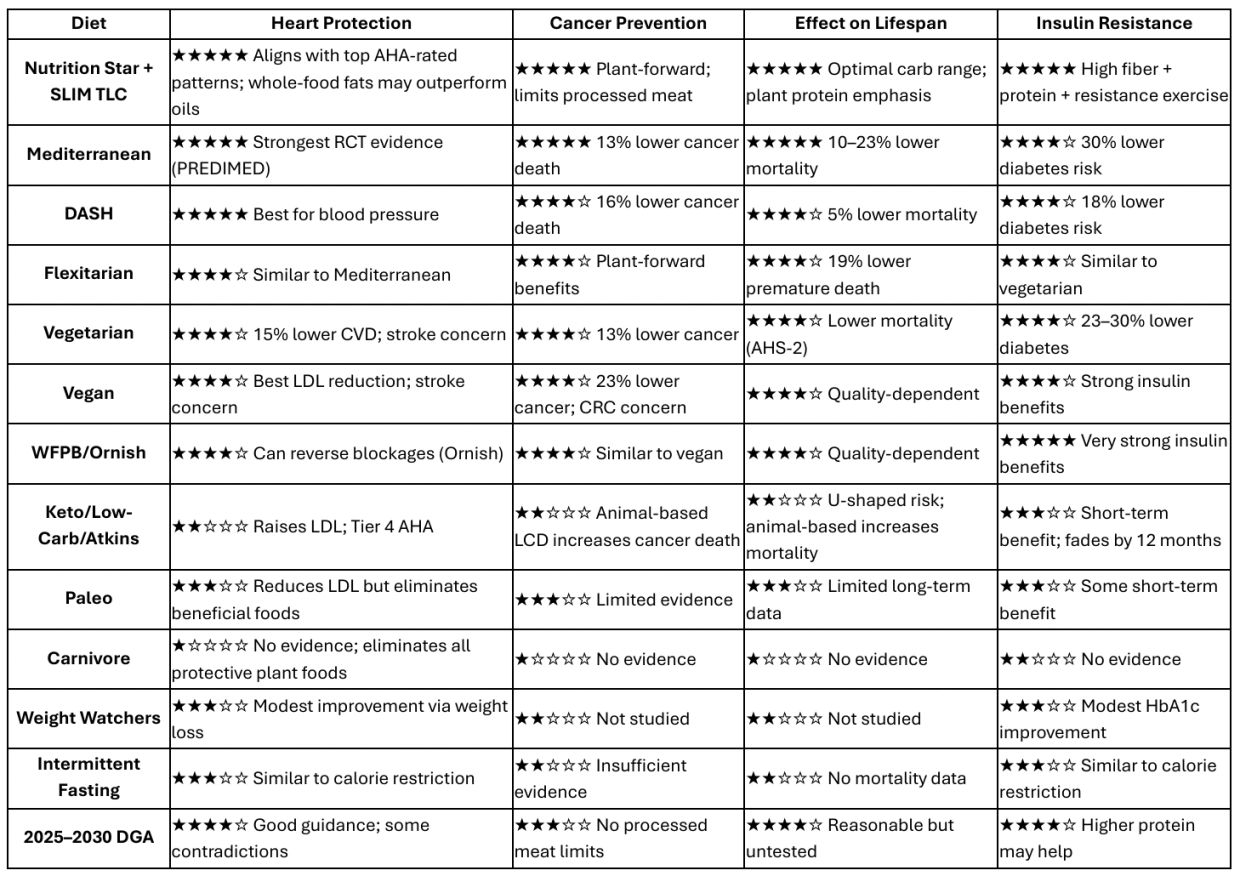
Heart Health, Cancer, and Lifespan
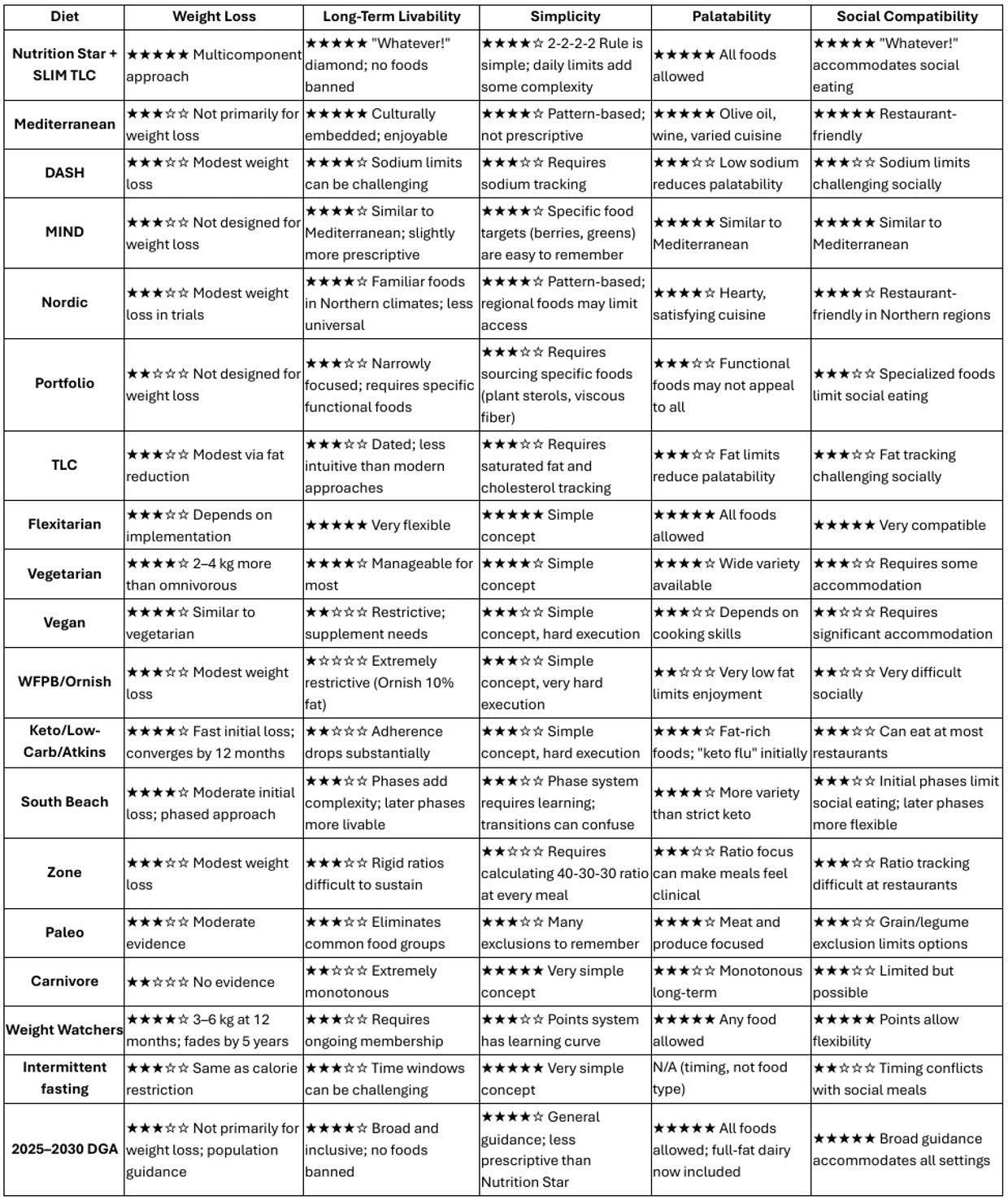
Weight Management, Simplicity, and Livability
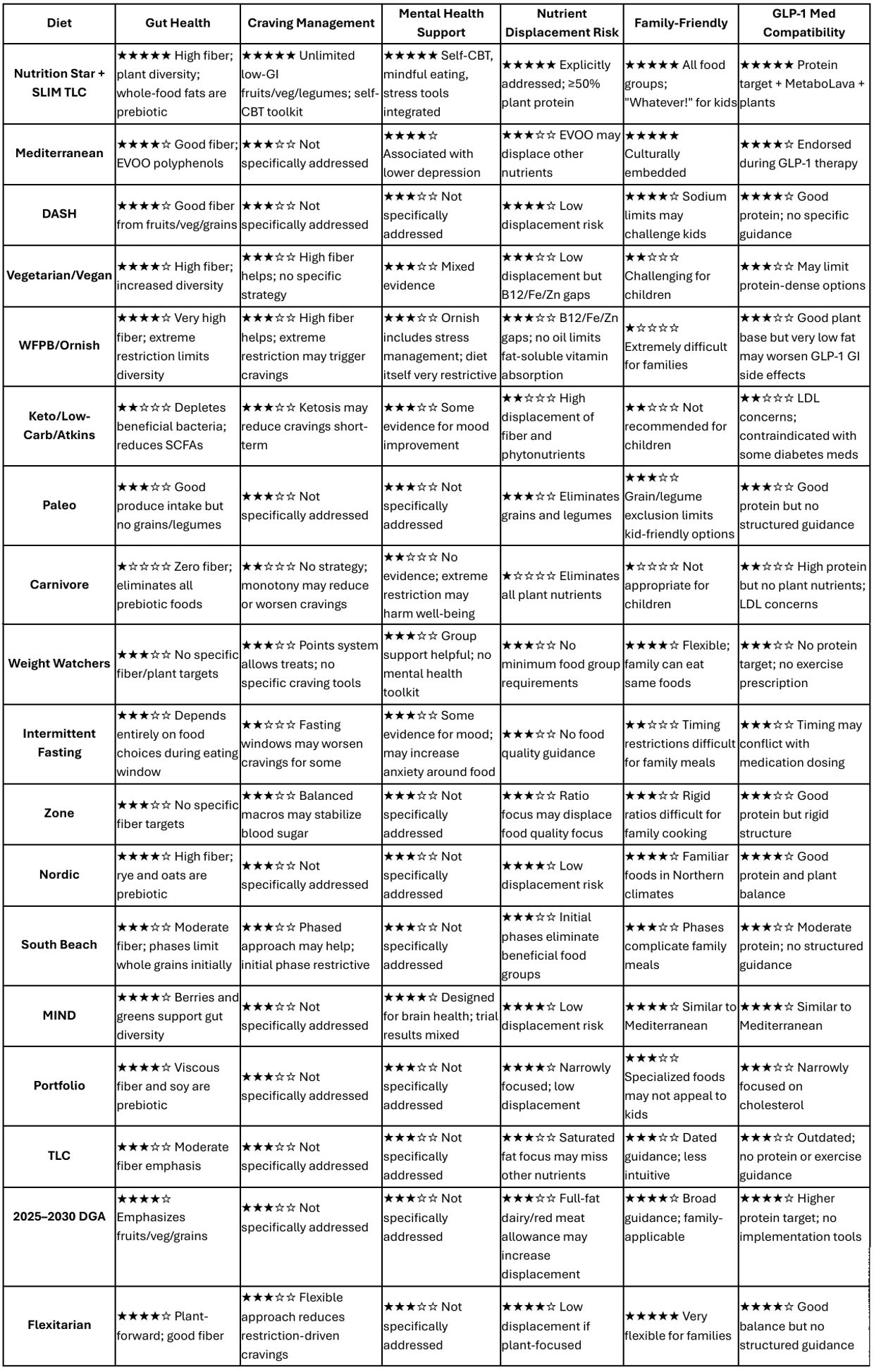
Gut Health, Craving Management, Mental Health, and Special Dimensions
Frequently Asked Questions
Q: Do I have to give up any foods?
A: No. The Nutrition Star doesn't ban any food. The "Whatever!" diamond gives you room for treats, desserts, and processed foods — just within a daily calorie limit. Research consistently shows that flexible approaches work better than rigid ones.
Q: Is this safe for my children?
A: Yes. Because no food groups are eliminated and the plan emphasizes whole, nutrient-dense foods, it is appropriate for the whole family. The "Whatever!" diamond is especially important for children, who need flexibility and should never feel restricted.
Q: What if I'm taking Ozempic, Wegovy, Mounjaro, or Zepbound?
A: The Nutrition Star + SLIM TLC is specifically well-suited for people on these medications. The protein target and MetaboLava exercises help protect your muscle mass, and the whole-food approach helps minimize side effects like nausea. The comprehensive lifestyle program also helps you build habits that can sustain your weight loss if you eventually reduce or stop the medication.
Q: How is this different from just "eating healthy"?
A: "Eat healthy" is vague advice that rarely works. The Nutrition Star gives you specific daily targets, a visual framework (the Five Diamonds), and a craving management strategy. SLIM TLC adds the exercise, sleep, stress, and mental health tools that research shows are essential for lasting change.
Q: What if I have diabetes, heart disease, or kidney disease?
A: The Nutrition Star's principles are well-aligned with guidelines for these conditions, but specific modifications may be needed (e.g., sodium limits for heart disease, potassium/phosphorus adjustments for kidney disease). Always work with your healthcare provider to tailor the plan to your medical needs.
Q: Can I do intermittent fasting with this?
A: Yes — SLIM TLC includes optional intermittent fasting guidance for those who find it helpful. Research shows IF works about as well as simply eating fewer calories, so it's offered as a tool, not a requirement. The most important thing is what you eat, not just when.
The Bottom Line
The Nutrition Star + SLIM TLC combines the best-proven elements of the world's healthiest dietary patterns — Mediterranean, DASH, and flexitarian — into a single, practical system with built-in flexibility and a comprehensive lifestyle program. It is designed to be:
- Effective — based on the strongest available scientific evidence
- Livable — no foods are forbidden; the "Whatever!" diamond keeps it real
- Complete — addresses nutrition, exercise, sleep, stress, cravings, and mental health
- Family-friendly — works for everyone at the table
- Future-proof — compatible with weight-loss medications and aligned with the latest dietary guidelines
Your health is a journey, not a destination. The Nutrition Star lights the way; SLIM TLC gives you the map.